
Build-A-Bot Puzzle: How to Play
Written by the AIVX Labs team · Published August 2026 · Updated August 2026
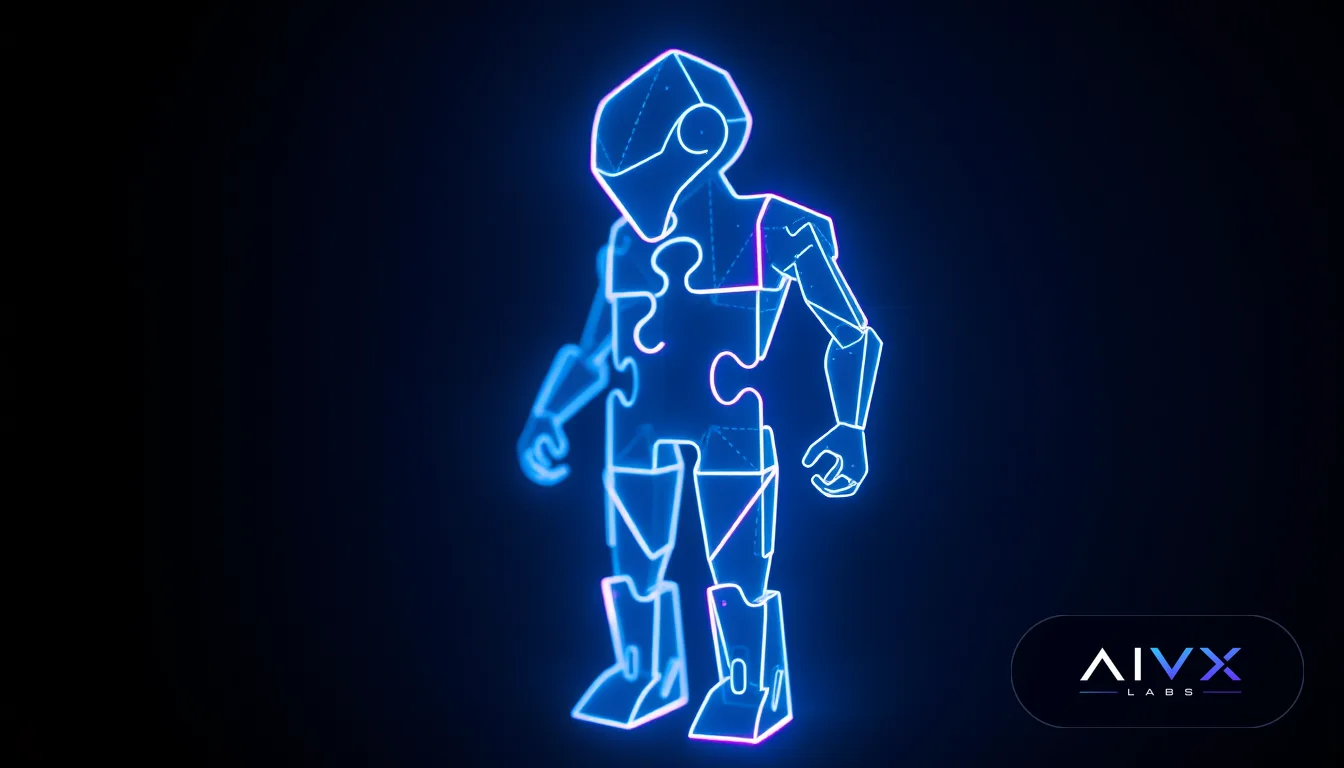
Build-A-Bot Puzzle is a drag-and-drop tetromino puzzle on AIVX Labs: you fill in a business or AI-themed silhouette — a lightning bolt, a robot, a gear — using shape-matched blocks pulled from a bank. Placement is forgiving, identical shapes are fully interchangeable, and clearing a round reveals a real business tip.
Key takeaways
- You fill in a silhouette (lightning bolt, robot, gear, etc.) using tetromino-shaped blocks pulled from a bank/tray.
- Placement is forgiving: blocks can be dropped anywhere on the board and only lock in when they land on the right spot — there's no reject, shake, or snap-back penalty for exploring.
- Identical-shaped blocks are fully interchangeable — any block of a given shape fits any slot needing that shape, not one specific pre-assigned piece.
- Wrong placements just return to the bank, so you can experiment freely.
- Each round is drawn randomly from a pool of puzzles (roughly 6 to 15 pieces), 4 rounds per session, with difficulty ramping up and a real business tip revealed when you clear a round.
The objective: filling a silhouette
Each puzzle presents an outline — a lightning bolt, a robot, a gear, or another business/AI-themed shape — that you need to fill in completely using tetromino-shaped blocks. The blocks live in a bank (a tray) off to the side, and you drag them onto the board one at a time to cover the silhouette.
Interchangeable pieces
This is the mechanic that sets Build-A-Bot Puzzle apart from a typical jigsaw-style puzzle: pieces aren't pre-assigned to one specific slot. Any block of a given tetromino shape is interchangeable with any other block of that same shape — if a slot needs an L-shaped piece, any L-shaped block from the bank works, not one specific piece the game has earmarked for that exact spot. That makes the puzzle genuinely about spatial reasoning (which shape goes where), not about hunting for one uniquely correct piece.
Forgiving placement — why it matters
You can drop a block anywhere on the board while you're figuring out where it belongs. There's no reject animation, no shake, and no snap-back penalty for placing it somewhere wrong — a block only locks into place once it lands on a spot where it correctly fits. If it doesn't fit where you dropped it, it simply returns to the bank. That means exploring the board — trying a piece in a few different spots to see what fits — costs you nothing, which keeps the puzzle low-friction even as the shapes get more complex.
Rounds and difficulty
A session consists of 4 rounds. Each round is pulled randomly from a pool of puzzles that range from roughly 6 to 15 pieces, and difficulty increases as you move through the session, so round 4 asks more of you spatially than round 1. Clearing each round reveals a real business tip, so there's a small payoff of actual content tied to your progress, not just a completed board.
See the rest of the arcade lineup at free AI arcade games.
Read our featured article on LinkedIn
Every course and tool mentioned here is included free on AIVX Labs.
Create Your Account NowFrequently asked questions
What am I actually building in Build-A-Bot Puzzle?
A business or AI-themed silhouette — examples include a lightning bolt, a robot, and a gear — filled in completely using tetromino-shaped blocks pulled from a bank.
Do I have to place a specific block in a specific slot?
No. Identical-shaped blocks are fully interchangeable, meaning any block of a given shape fits any slot on the board that needs that shape — there's no single pre-assigned piece for each spot.
What happens if I drop a block in the wrong place?
Nothing bad. Blocks can be dropped anywhere on the board with no reject, shake, or snap-back penalty. They only lock in when they land on a correct spot; otherwise they simply return to the bank so you can try again.
How many rounds are in a session, and do they get harder?
A session has 4 rounds, each drawn randomly from a pool of puzzles ranging from roughly 6 to 15 pieces, with difficulty ramping up as you progress.
What do I get for clearing a round?
Clearing a round reveals a real business tip, so progress in the puzzle is paired with actual takeaway content, not just a score.